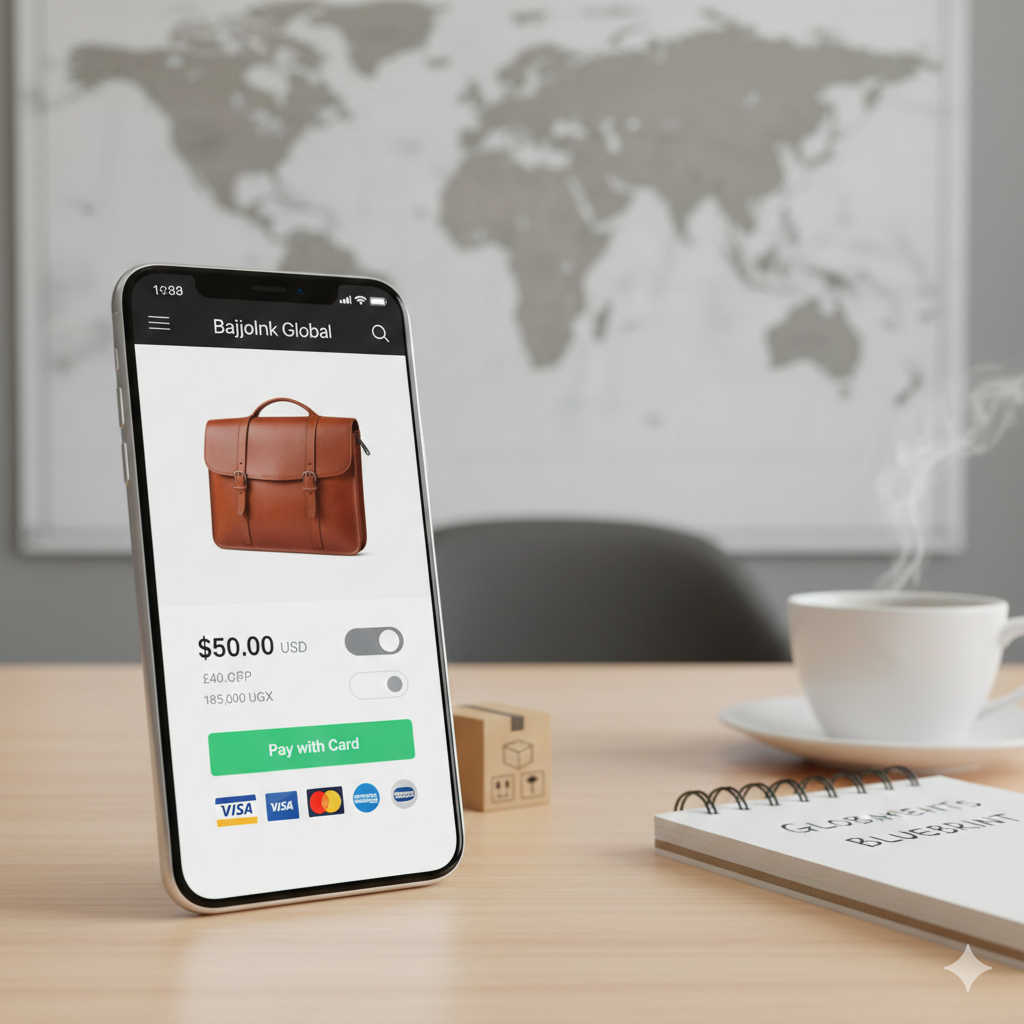
If you’ve been following the BajjoInk guide to digital entrepreneurship, you’ve likely mastered the "Local Game." You’ve got your MTN MoMo and Airtel Money integrations running, and your WhatsApp is buzzing with local orders.
But there is a ceiling to selling only in UGX. To build a true "Digital Empire," you need to be able to accept payments while you sleep—from a student in London, a professional in Nairobi, or a diaspora Ugandan in New York.
Moving beyond Mobile Money isn't just about "more money"; it’s about credibility, automation, and scale. Here is how you prepare your store for the global stage.
1. The "Trust Gap" and Why Cards Matter
For a local customer in Kampala, seeing a MoMo number is a sign of familiarity. For a customer in the UK or USA, it’s a red flag. Global shoppers rely on Visa, Mastercard, and American Express. If your website doesn’t offer a secure card checkout, you aren't just losing a sale; you are losing your reputation. Global payment gateways provide "Buyer Protection," which gives international customers the confidence to enter their details on a .ug or .org site.
2. Choosing Your Global Gateway
You don’t need a bank account in South Africa to sell globally. Several aggregators work perfectly for Ugandan entrepreneurs:
- Flutterwave / Pesapal: These are the "Big Two" for East African businesses. They allow you to accept international cards and settle the funds directly into your local bank account or even your mobile money wallet.
- Stripe (The "Gold Standard"): While not natively available for Ugandan residents, many high-level entrepreneurs use Stripe Atlas to incorporate a business in the US. This opens doors to Apple Pay and Google Pay—the fastest checkout methods in the world.
3. Multi-Currency: The Psychological Switch
Seeing a price like 185,000 UGX is overwhelming for someone used to Dollars or Euros.
- The Strategy: Use a Currency Switcher on your website. Modern e-commerce platforms like Shopify or WooCommerce can detect a user’s IP address and automatically show your product as $50 instead of a six-figure local price.
- Pro Tip: Keep your "Base Currency" in UGX to avoid reconciliation headaches, but let the front-end do the math for your global visitors.
4. Logistics: The "Last Mile" is Now the "First Mile"
Global payments are useless if you can't deliver the goods. When you move to global e-commerce, your shipping policy must be crystal clear.
- Partner Up: Don’t try to guess shipping costs. Integrate with DHL, Aramex, or FedEx. They have plugins that calculate real-time shipping rates at checkout based on the weight of the item and the destination.
- The "Digital" Loophole: If you are selling digital products (e-books, courses, or consulting), you have 0% shipping costs. This is the fastest way to scale a global empire from a desk in Kampala.
5. Security and Compliance (The Boring but Vital Part)
When you handle card data, you enter the world of PCI DSS compliance.
- Never store a customer's card number on your own server.
- Always use a "hosted checkout" where the payment gateway handles the sensitive data. This protects you from hackers and ensures you stay on the right side of international financial laws.
The Big Picture
Mobile Money is the king of the local streets, but Credit Cards are the keys to the kingdom. By integrating a global payment gateway, you stop being a "local shop" and become a "global brand."
The world is ready to buy what you’re selling. Are you ready to let them pay?